Hector’s dolphins (Cephalorhynchus hectori) are the world’s smallest and rarest marine dolphins, found exclusively in New Zealand’s coastal waters. Distinguished by their unique rounded dorsal fins resembling Mickey Mouse ears and distinct black-and-grey markings, these endangered mammals are primarily located around the South Island, with a critical calving season occurring during the summer months from November to February.
What are Hector’s Dolphins?
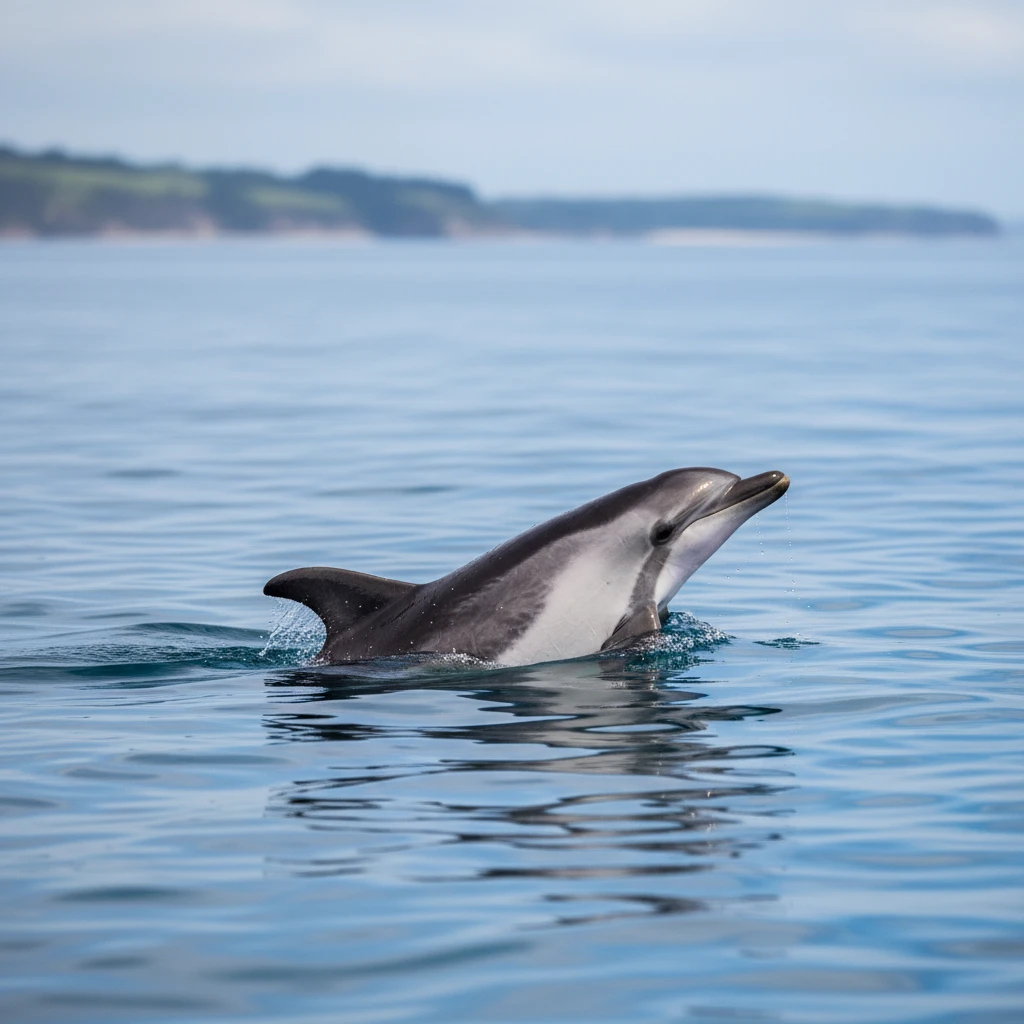
When compiling essential hectors dolphin facts nz for eco-tourism or academic research, the most striking feature is their diminutive stature. As the smallest marine dolphin species globally, adults typically measure only 1.2 to 1.5 meters (4 to 5 feet) in length and weigh between 40 and 60 kilograms (88 to 132 pounds). Unlike the more common Bottlenose dolphin, which has a sleek, falcate (curved) dorsal fin, the Hector’s dolphin possesses a rounded dorsal fin that is often compared to a Mickey Mouse ear.
These dolphins are endemic to New Zealand, meaning they are found nowhere else on Earth. Their bodies are stout and robust, featuring a distinctive color palette of grey, black, and white. The face, flippers, dorsal fin, and tail are black, while the body is predominantly light grey. A striking white “finger” mark extends from the belly along the flanks towards the tail, making them easily identifiable in the water.
Behaviorally, Hector’s dolphins are known for being less acrobatic than their Dusky or Bottlenose counterparts. While they do breach, they are more commonly observed “logging” (floating on the surface) or swimming quietly in small pods of two to eight individuals. However, they are curious by nature and are frequently attracted to small vessels moving at slow speeds, a trait that endears them to tourists but also exposes them to risks from boat propellers.
Identifying Hector’s vs. Maui Dolphins
A common point of confusion for travelers involves distinguishing between Hector’s dolphins and Maui dolphins. While they look nearly identical, understanding the difference is crucial for accurate hectors dolphin facts nz context.
Taxonomy and Genetics:
The Maui dolphin (Cephalorhynchus hectori maui) is actually a subspecies of the Hector’s dolphin. Genetic studies have shown sufficient differences to classify them separately. The Maui dolphin has a slightly larger skull and wider rostrum (snout) than the South Island Hector’s dolphin, though these differences are impossible to spot with the naked eye during a boat tour.
Geographic Distribution:
The primary method of identification is location. Hector’s dolphins are found around the South Island of New Zealand, with high concentrations in Banks Peninsula, the West Coast, and Te Waewae Bay. Conversely, Maui dolphins are critically endangered and restricted to the west coast of the North Island, primarily between Maunganui Bluff and Whanganui.
Population Numbers:
The most alarming difference lies in their population status. While Hector’s dolphins number roughly 15,000 individuals, the Maui dolphin population is estimated to be fewer than 60 individuals, placing them on the brink of extinction. Seeing a Hector’s dolphin in the South Island is a relatively reliable occurrence in specific hotspots; seeing a Maui dolphin is an exceedingly rare event.
The Summer Calving Season (Dec-Feb)
For eco-tourists planning a trip to New Zealand, understanding the reproductive cycle is vital, as the presence of calves significantly alters viewing protocols and dolphin behavior.
When are Hector’s dolphin calves born?
Hector’s dolphins have a distinct seasonal breeding pattern. The peak calving season occurs during the New Zealand summer, specifically from November to mid-February. During this period, female dolphins move closer to shore, utilizing shallow, sheltered bays and harbors as nurseries. This behavior protects the calves from predators such as sharks and killer whales (orca) that patrol deeper waters.
Females give birth to a single calf every two to three years. The gestation period is approximately one year. At birth, the calves are remarkably small—roughly the size of a rugby ball (about 60-70 cm long)—and display darker coloration than adults. They also possess distinct “fetal fold” marks on their sides from being curled inside the womb, which fade as they mature.

Maternal Care and Behavior
The bond between mother and calf is intense. Calves swim in the “echelon position” alongside the mother’s dorsal fin, allowing them to slipstream and conserve energy. They nurse for roughly one to two years, which is a significant investment of energy for the mother. Because the reproductive rate is so slow, the survival of every calf is critical for the species’ long-term viability.
During the summer months, tourists in areas like Akaroa Harbour are far more likely to see these nursery groups. However, the presence of calves triggers strict regulations regarding boat interaction to prevent separating the mother and baby, which is often fatal for the calf.
Akaroa Harbour Boat Rules & Interaction
Akaroa Harbour, located on the Banks Peninsula roughly 90 minutes from Christchurch, is the premier destination for viewing Hector’s dolphins. It hosts a resident population of approximately 1,000 dolphins. To protect this population, specifically during the high-traffic summer tourism season, the Department of Conservation (DOC) enforces a strict code of conduct.
What are the rules for boating near dolphins?
Whether you are on a commercial eco-tour or a private recreational vessel, you must adhere to the Marine Mammals Protection Regulations. Failure to do so can result in prosecution.
- The “No Wake” Rule: Vessels must travel at a “no wake” speed (generally under 5 knots) within 300 meters of any dolphin. High speeds can cause disorientation and physical injury from boat strikes.
- Approach Angles: You must approach dolphins from behind and to the side. Never cut through a pod or approach head-on.
- Duration of Encounter: Interaction time should be limited. If the dolphins show signs of agitation (tail slapping, chuffing, or diving repeatedly), the vessel must disengage immediately.
- Swimming Limitations: While commercial “swim with the dolphins” tours operate in Akaroa, they are subject to moratoriums. If a calf is present in the pod, swimming is strictly prohibited. Operators are trained to identify juveniles and will cancel swim operations in that specific area to avoid stress.
It is important for independent travelers renting boats or kayaks to understand that the dolphins often approach the vessel. In this scenario, the engine should be placed in neutral until the dolphins move away. Do not attempt to pursue them.

Best Shore-based Viewing Locations
For those who prefer to stay on dry land or wish to avoid the costs of commercial charters, Hector’s dolphins are one of the few cetacean species easily viewable from shore due to their preference for shallow coastal waters (often less than 100 meters deep).
Banks Peninsula
Beyond Akaroa Harbour, the entire Banks Peninsula offers vantage points. Driving the Summit Road offers panoramic views, but for dolphin spotting, you need to get to sea level.
- The Akaroa Waterfront: It is not uncommon to see dolphins patrolling the water right off the main wharf or near the lighthouse, particularly early in the morning or at dusk.
- Tuhura/Flea Bay: Located on the southeastern side of the peninsula, this marine reserve area is rich in wildlife. While access requires a 4WD vehicle, the isolation often rewards visitors with undisturbed sightings.
The West Coast
The West Coast of the South Island holds significant populations of Hector’s dolphins, particularly around Buller and Haast.
- Westport & The Buller River Mouth: Dolphins are frequently seen playing in the surf where the river meets the Tasman Sea.
- Jackson Bay: Further south near Haast, this quiet bay is a known habitat. The calm waters allow for excellent visibility from the pier or the beach.
The Catlins
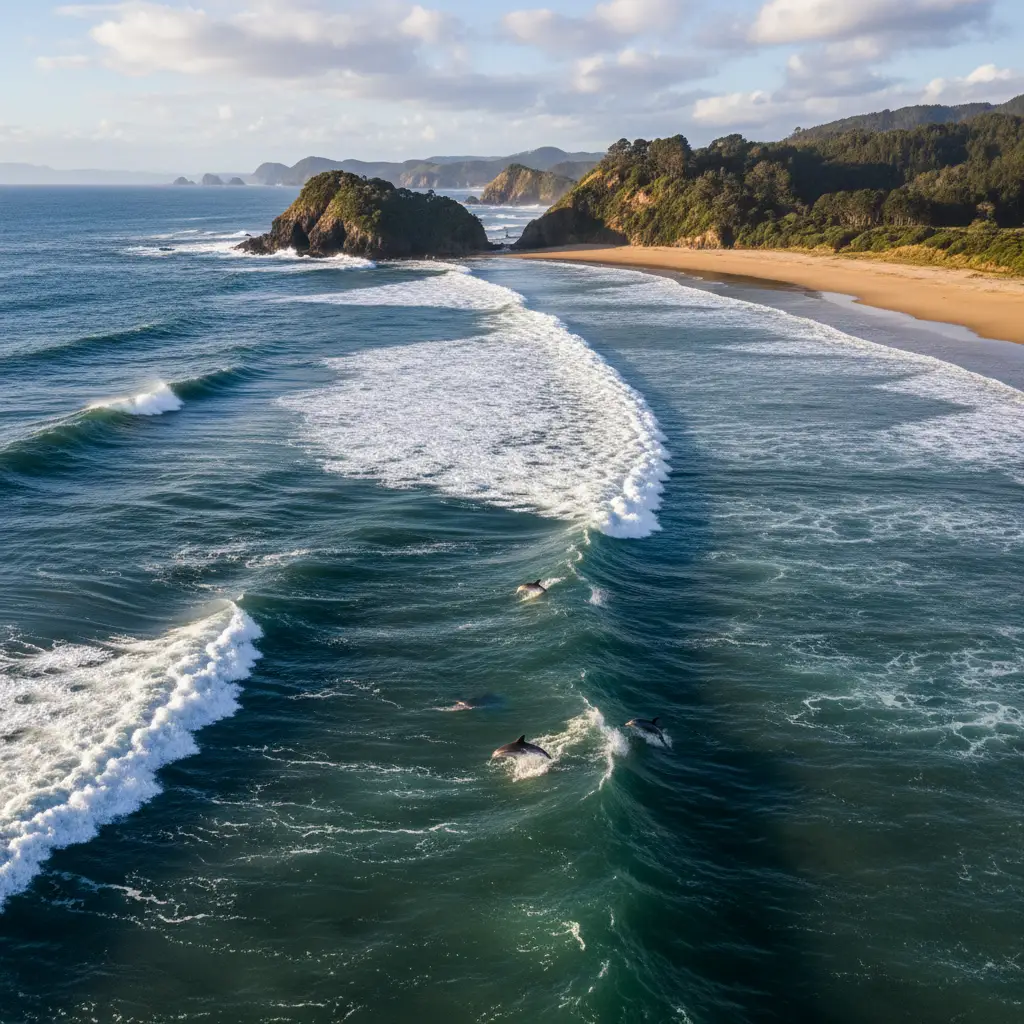
Curio Bay/Porpoise Bay: This is arguably the best shore-based viewing location in the country. In summer, Hector’s dolphins (often locally referred to as porpoises, though this is taxonomically incorrect) surf the waves within meters of the beach. Visitors can stand on the rocks or the sandy beach and watch them for hours. Note that while people do surf and swim here, the DOC requests that swimmers do not actively chase or surround the dolphins.
Conservation Status and Threats
Despite being a “bucket list” item for travelers, the reality of the Hector’s dolphin existence is precarious. They are classified as Nationally Vulnerable under the New Zealand Threat Classification System and Endangered on the IUCN Red List.
Why are Hector’s dolphins endangered?
The primary threat to Hector’s dolphins is bycatch in fishing gear. Because they inhabit shallow coastal zones, they share their habitat with commercial and recreational gillnets (set nets) and trawlers. The dolphins cannot detect the fine monofilament nets with their sonar, leading to entanglement and drowning.
Significant strides have been made with the establishment of Banks Peninsula Marine Mammal Sanctuary and restrictions on set netting in various coastal zones. However, conservation groups advocate for wider bans on set nets to ensure the population can recover. Other threats include:
- Toxoplasmosis: A disease spread by cat feces entering waterways, which is fatal to dolphins.
- Boat Strike: High-speed recreational vessels in harbor areas.
- Seabed Mining and Pollution: Habitat degradation affects their food supply.
By choosing responsible eco-tourism operators who contribute to conservation funds and adhering to viewing guidelines, visitors play a small but vital role in the protection of this unique Kiwi species.
Frequently Asked Questions
Can you swim with Hector’s dolphins in New Zealand?
Yes, but only with licensed tour operators in designated areas like Akaroa. Swimming is heavily regulated; if calves are present, swimming is prohibited to protect the young dolphins. Independent swimming with them is discouraged by the Department of Conservation to prevent harassment.
How many Hector’s dolphins are left in the wild?
The population is estimated to be around 15,000 individuals. While this is higher than the critically endangered Maui dolphin (under 60 individuals), the species remains vulnerable due to their slow reproductive rate and coastal threats.
What do Hector’s dolphins eat?
They are opportunistic feeders that primarily consume small fish and squid found in shallow coastal waters. Common prey includes red cod, ahuru, arrow squid, and stargazer. They use echolocation to find food in the often murky coastal waters.
Why are they called Hector’s dolphins?
They were named after Sir James Hector, a 19th-century scientist and the curator of the Colonial Museum in Wellington (now Te Papa). He was the first to scientifically examine the specimen after it was brought to him in the 1870s.
How long do Hector’s dolphins live?
Hector’s dolphins have a maximum life expectancy of roughly 20 to 25 years. This is relatively short compared to other dolphin species. Combined with their late maturity (females don’t breed until age 7-9), this makes population recovery slow.
Are Hector’s dolphins friendly?
They are generally curious and attracted to slow-moving boats, often riding the bow waves. However, they are wild animals. Their “friendliness” is often an investigation of their environment. Unlike Bottlenose dolphins, they are less likely to perform high jumps or aerial acrobatics.