Family stargazing in New Zealand offers a unique educational adventure where children and parents explore the southern hemisphere’s clearest skies. From the Aoraki Mackenzie Dark Sky Reserve to Stewart Island, these experiences combine scientific learning with Māori astronomy, providing safe, accessible observatories and tours tailored specifically for young explorers looking to witness the Southern Lights and the Milky Way.
Why Stargazing is Great for Kids?
In an era dominated by screens and instant gratification, introducing children to the wonders of the night sky provides a profound counter-narrative. Family stargazing New Zealand style is not merely about looking upwards; it is about reconnecting with the natural world on a cosmic scale. New Zealand, or Aotearoa, is uniquely positioned to offer this experience due to its low population density and minimal light pollution.
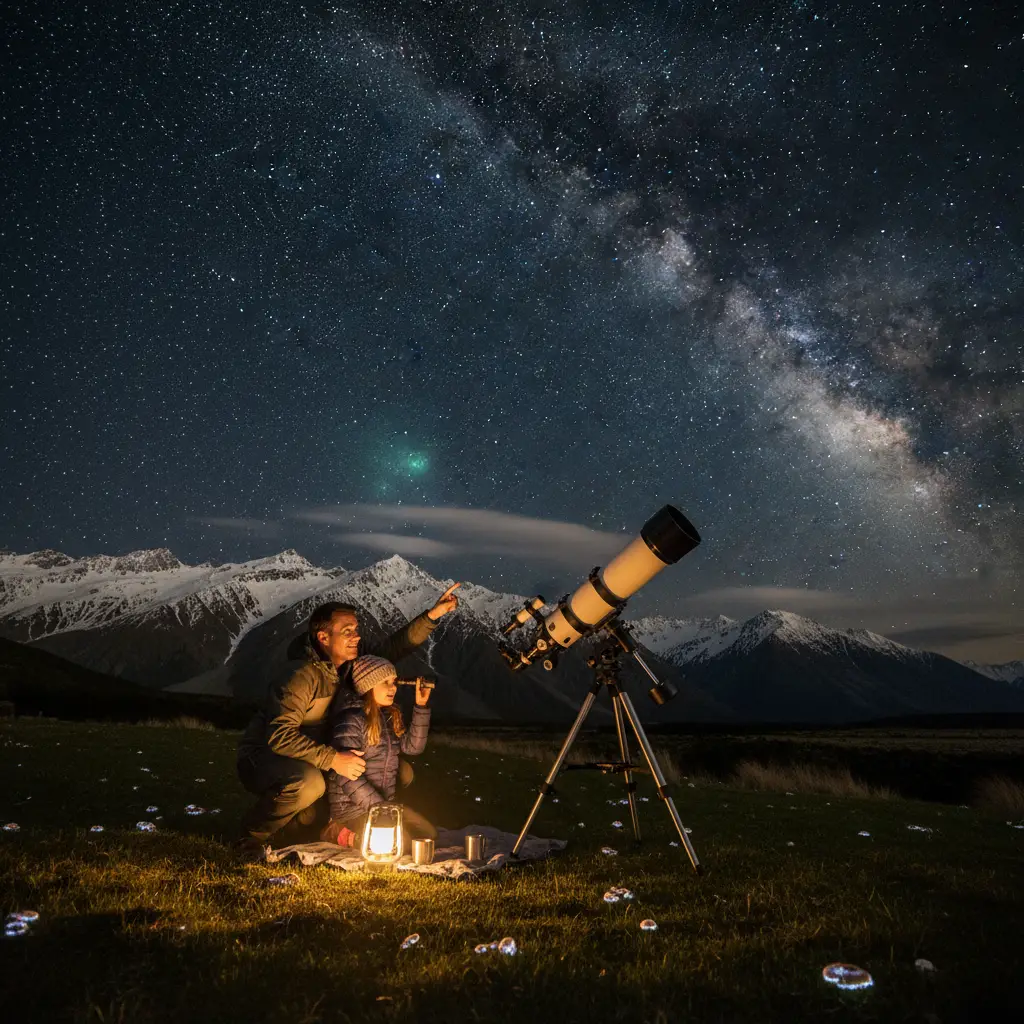
Stargazing fosters a sense of wonder and humility. When children view the craters of the moon through a telescope or trace the spine of the Milky Way with the naked eye, they begin to grasp concepts of distance, time, and scale that are difficult to teach in a classroom. It encourages patience and observation—skills that are critical for cognitive development. Furthermore, the shared family experience of navigating the dark creates lasting memories, bonding parents and children through a shared sense of discovery.
Sparking Interest in STEM
Astronomy is often called the “gateway science.” It naturally integrates physics, chemistry, and mathematics in a way that is visually arresting rather than abstract. Seeing the rings of Saturn or the nebulas in the Orion constellation can ignite a lifelong passion for Science, Technology, Engineering, and Math (STEM). New Zealand’s astrotourism operators are well-versed in communicating complex scientific concepts to younger audiences, making the physics of light and gravity accessible and exciting.
What is the Educational Value of Dark Sky Reserves?
New Zealand is a world leader in Dark Sky conservation, hosting several accredited International Dark Sky Sanctuaries and Reserves. For families, visiting these reserves offers a dual educational benefit: environmental conservation and cultural heritage.
Understanding Light Pollution and Conservation
Visiting a Dark Sky Reserve, such as the Aoraki Mackenzie International Dark Sky Reserve, provides a tangible lesson in environmental stewardship. Kids learn that light pollution is not just an annoyance for astronomers but a disruption to wildlife and human circadian rhythms. Guides often explain how the region limits blue light emissions and uses shielding on streetlights to protect the pristine darkness. This instills a value of conservation that goes beyond just recycling; it teaches children to value the natural darkness as a resource worth protecting.
Māori Astronomy (Tātai Arorangi)
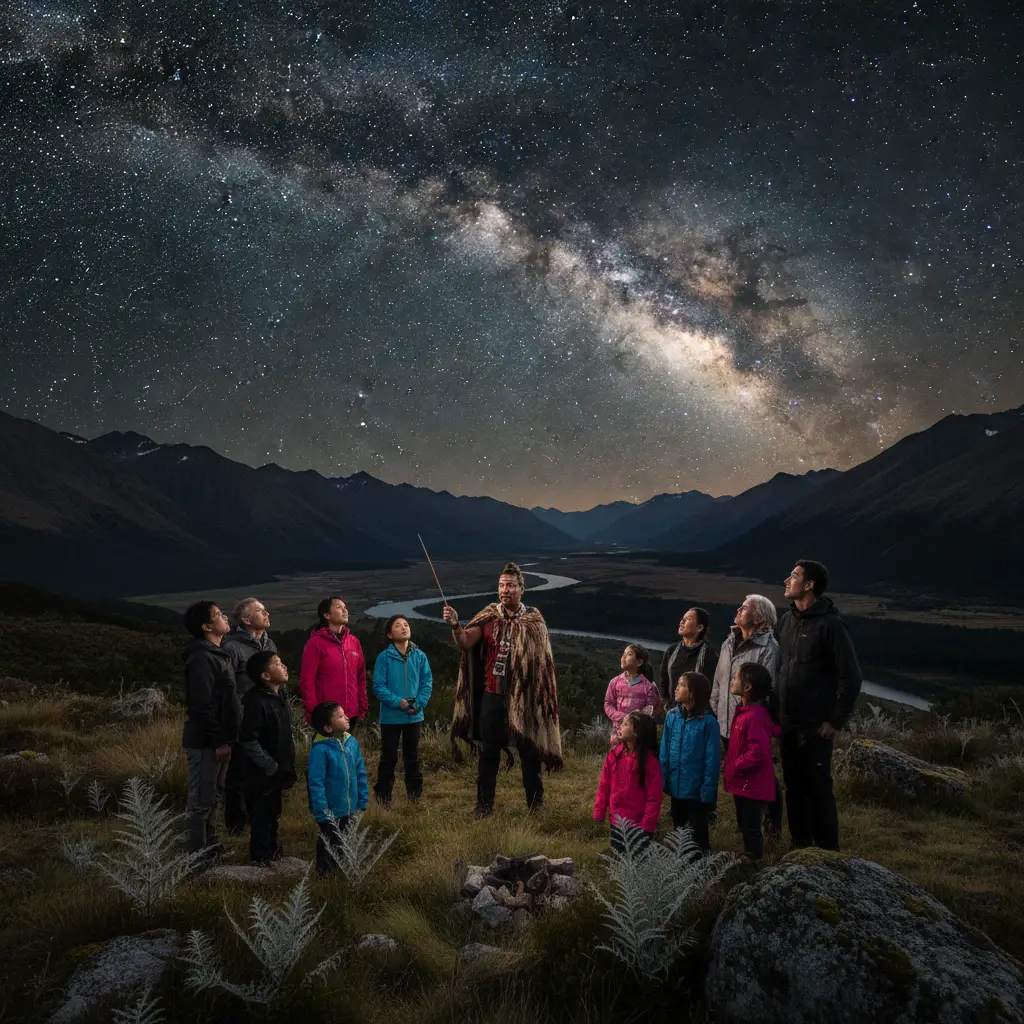
A critical component of family stargazing in New Zealand is the integration of Māori astronomy, known as Tātai Arorangi. Unlike Western astronomy, which focuses heavily on Greek and Roman mythology, New Zealand tours often recount the legends of the sky from an indigenous perspective. Children learn how early Polynesian voyagers used the stars to navigate the vast Pacific Ocean to Aotearoa.
Learning about Matariki (the Pleiades cluster), which signals the Māori New Year, allows families to understand the deep cultural connection between the celestial bodies and life on earth, including harvesting and hunting cycles. This cross-cultural education enriches the scientific observation, providing a holistic view of the universe.
Where are the Best Spots for Family Stargazing in New Zealand?
Not all dark sky locations are created equal, especially when traveling with children. Accessibility, amenities, and climate play major roles in selecting the right destination.
Lake Tekapo and Mt. John Observatory
The crown jewel of New Zealand astrotourism is the Mackenzie Basin. The Dark Sky Project at Lake Tekapo offers family-friendly tours at the Mt. John Observatory. The infrastructure here is excellent, with warm cafes and easy access, making it ideal for younger children who may tire easily. The “Crater Experience” is specifically designed to be sheltered from the wind, providing a comfortable environment for families to view the Southern Cross and the Magellanic Clouds.
Great Barrier Island (Aotea)
For families seeking a more rugged adventure, Great Barrier Island is an International Dark Sky Sanctuary. Being an island off the coast of Auckland, it is completely off-grid. This location is perfect for older children and teens who enjoy nature and hiking. The lack of reticulated electricity on the island means the light pollution is virtually non-existent, offering one of the darkest skies on the planet.
Rakiura (Stewart Island)
Located at the very bottom of New Zealand, Rakiura means “The Land of Glowing Skies.” It is the southernmost Dark Sky Sanctuary in the world. This is the prime location for families hoping to catch a glimpse of the Aurora Australis (Southern Lights). While the weather can be unpredictable, the reward of seeing the sky dance in sheets of green and pink is an unforgettable family memory.

What are the Safety Considerations for Families?
While stargazing is generally a low-risk activity, the environment in which it takes place—dark, often remote, and cold—requires specific safety planning for families.
Managing Cold Temperatures
New Zealand’s clearest skies often occur on the coldest nights, particularly in the South Island where temperatures can drop well below freezing. Hypothermia is a genuine risk for young children who may not recognize they are getting too cold.
Safety Tip: Dress in layers. Start with merino wool base layers, add a fleece mid-layer, and finish with a windproof and waterproof down jacket. Hats, gloves, and thick socks are non-negotiable, even in summer months at high altitudes.
Navigating in the Dark
Walking around rocky terrain or near lakes in pitch darkness presents tripping hazards.
Safety Tip: Equip every family member with a red-light torch (flashlight). White light ruins night vision (which takes 20 minutes to adapt), whereas red light allows you to see where you are walking without blinding your eyes to the stars. Many commercial tours provide these, but having your own ensures safety during independent exploration.
Night Driving
Reaching dark sky locations often involves driving on unlit, winding rural roads. New Zealand roads can be narrow and icy.
Safety Tip: If you are renting a car, ensure you are comfortable driving on the left side of the road. Avoid driving long distances late at night after a tour when fatigue sets in. Plan to stay overnight near the observatory location.
How to Balance Sleep Schedules with Night Tours?
One of the biggest challenges for parents planning a family stargazing New Zealand trip is the timing. True darkness doesn’t fall until late, especially in the summer (December to February) when sunset can be as late as 9:30 PM. Keeping kids awake and happy requires strategic planning.
Travel in Winter or Shoulder Season
Contrary to popular belief, winter (June to August) is often the best time for family astrotourism. The sun sets as early as 5:00 PM, meaning you can enjoy a full stargazing tour and have the children in bed by 8:30 PM. This aligns perfectly with normal sleep routines and avoids the meltdown associated with overtiredness. Additionally, the galactic center of the Milky Way is most visible during the winter months.
The Strategic Nap
If you are visiting in summer, enforce a late afternoon “siesta” or quiet time. Pushing dinner back to a later time can also help shift the body clock slightly for the duration of the trip. Treat the stargazing night as a special “midnight adventure” (even if it’s only 10 PM) to frame the sleep disruption as exciting rather than exhausting.
Stay On-Site
Choose accommodation within the Dark Sky Reserve. Many holiday parks and lodges in Tekapo and Twizel have glass ceilings or expansive decks. This allows you to put younger children to bed while parents or older siblings continue to stargaze just meters away, ensuring everyone gets what they need without logistical nightmares.

Essential Gear for Young Astronomers
You don’t need to be a professional astronomer to enjoy the skies, but having the right tools can enhance the experience significantly for kids.
- Binoculars over Telescopes: For families on the move, a good pair of 10×50 binoculars is often better than a cheap telescope. They are intuitive for kids to use and offer wide-field views of star clusters like the Jewel Box.
- Star Chart Apps: Download apps like Stellarium or Star Walk 2 before you go. These use the phone’s GPS to identify constellations when you point the device at the sky. (Remember to use the app’s “night mode” to protect your night vision).
- Planispheres: A physical, rotating star wheel specific to the Southern Hemisphere is a great hands-on tool for kids to learn navigation without screens.
- Thermos and Snacks: Never underestimate the power of hot chocolate and energy-dense snacks to keep morale high in the cold.
Conclusion
Family stargazing in New Zealand is more than a tourist activity; it is an immersion into science, culture, and nature. By balancing the educational opportunities of Dark Sky Reserves with practical safety and sleep considerations, you can create a travel experience that expands your children’s horizons—literally and figuratively. Whether you are hunting for the Aurora on Stewart Island or learning Māori legends in Tekapo, the southern skies promise an adventure that will leave your family starstruck.
People Also Ask
What is the best time of year for stargazing in New Zealand?
Winter (June to August) is generally considered the best time. The nights are longer, meaning tours can start earlier (great for kids), and the galactic core of the Milky Way is most visible. However, stargazing is a year-round activity in NZ.
Can you see the Southern Lights (Aurora Australis) in New Zealand?
Yes, but it requires patience and the right conditions. The best chances are in the lower South Island (Stewart Island, The Catlins, Lake Tekapo) during the winter months during periods of high solar activity.
Is stargazing suitable for toddlers?
While toddlers may not grasp the scientific concepts, they often enjoy the sensory experience of the night. However, due to late hours and cold temperatures, it is often better suited for children aged 5 and up. Many tours have age restrictions, so check beforehand.
Do I need to book a tour to see the stars?
No. In Dark Sky Reserves like the Mackenzie Basin, you can simply drive to a safe pull-off and look up. However, a tour provides access to powerful telescopes and expert guides who can explain what you are seeing, which adds immense educational value.
What should kids wear for stargazing tours?
Dress them as if they are going to the snow. Thermal base layers, fleece, a heavy waterproof jacket, beanie, gloves, and warm socks are essential. It is better to be too warm than to have the experience ruined by the cold.
Are there free places to stargaze in New Zealand?
Absolutely. Almost anywhere away from major cities (Auckland, Wellington, Christchurch) offers great views. Good free spots include the shores of Lake Tekapo, Castlepoint in Wairarapa, and Arthur’s Pass.