Native birds of Aotearoa encompass a diverse collection of avian species unique to New Zealand, ranging from the flightless, nocturnal Kiwi to the melodic Tui. Many of these species are endemic, having evolved in isolation for 80 million years, resulting in distinct biological traits not found anywhere else on Earth.
New Zealand is often referred to as the seabird capital of the world, but its land-based avifauna is equally remarkable. For eco-tourists and conservationists alike, understanding the native birds of Aotearoa is the first step toward appreciating the delicate ecological balance of these islands. Whether you are trekking through the podocarp forests of the North Island or navigating the alpine passes of the South, accurate identification enhances the experience and aids in citizen science efforts.
Forest Birds: The Melodic Canopy
The forests of New Zealand are alive with a chorus that Captain James Cook once described as “wild music.” Identifying the source of these songs requires a keen eye for plumage and an ear for distinct call patterns. The following species are the most common and charismatic inhabitants of the native bush.
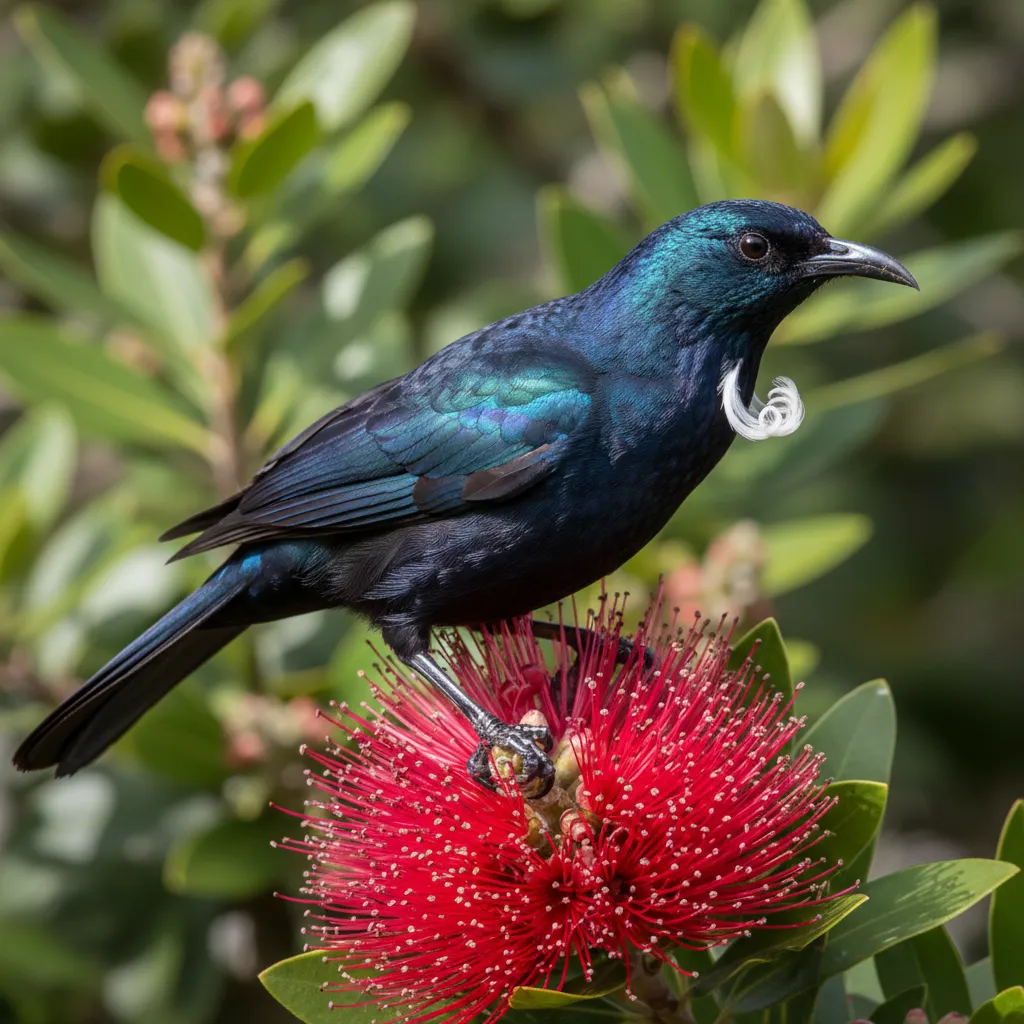
How do I identify a Tui?
The Tui (Prosthemadera novaeseelandiae) is arguably the most recognizable honeyeater in New Zealand. At first glance, the bird appears black, but under direct sunlight, its plumage reveals iridescent sheens of blue, green, and bronze. The most definitive identification feature is the poi—two distinctive white tufts of feathers at the throat, resembling a parson’s collar.
Behaviorally, Tuis are aggressive defenders of their territory, often seen chasing much larger birds away from prime nectar sources like flax (harakeke) and kōwhai. Their vocal range is extraordinary; they can sing two notes simultaneously and are known to mimic other birds, and even human sounds like car alarms. If you hear a series of clicks, cackles, and bell-like chimes, you are likely in the presence of a Tui.
What distinguishes the Bellbird (Korimako)?
Often confused with the Tui due to their shared habitat and nectar-feeding habits, the Bellbird (Anthornis melanura) is significantly smaller and lacks the white throat tufts. Males are olive-green with a slight purple sheen on the head, while females are a duller olive-brown with a subtle white stripe across the cheek.
The Bellbird’s song is the classic sound of the NZ bush—pure, bell-like notes that carry long distances. Unlike the Tui’s somewhat chaotic mix of sounds, the Bellbird’s call is generally more structured and melodic. Identification is best achieved by looking for the olive coloration and listening for a crystal-clear chiming sound, particularly at dawn and dusk.
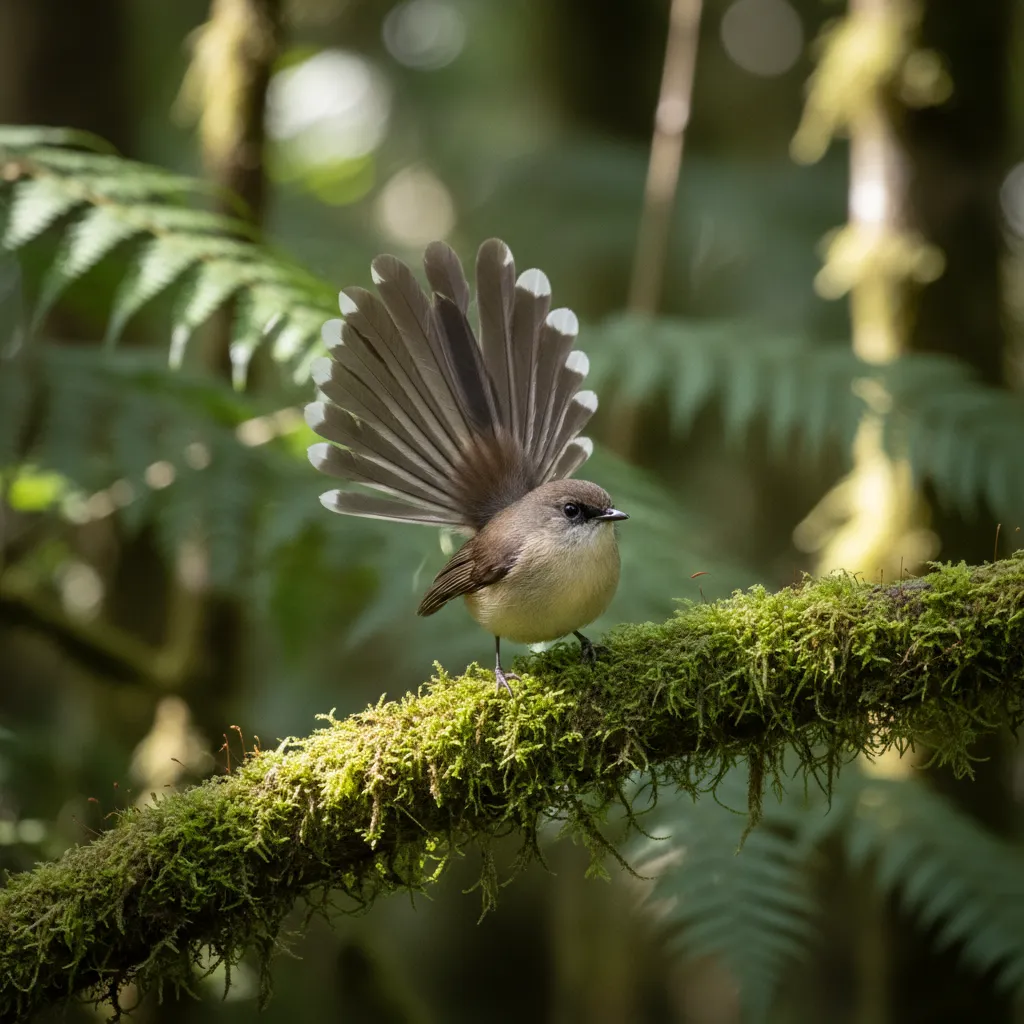
Why does the Fantail (Pīwakawaka) follow hikers?
The Fantail (Rhipidura fuliginosa) is one of the few native birds of Aotearoa that actively seeks out human interaction, though not for social reasons. As hikers move through the bush, they disturb insects. The Fantail uses its broad, fan-shaped tail to execute rapid aerial acrobatics, catching the disturbed moths and flies on the wing.
Identification is straightforward: look for a small bird with a long tail that fans out widely. There are two color morphs: the common pied morph (brown body, white eyebrows, black and white tail) and the rarer black morph (entirely dark sooty black), which is more common in the South Island. Their call is a distinctive, high-pitched “cheet-cheet-cheet,” often described as a kissing sound.
Flightless Icons: Ground Dwellers
New Zealand’s isolation allowed for the evolution of flightless birds, filling niches usually occupied by mammals. These species are the crown jewels of NZ eco-tourism.
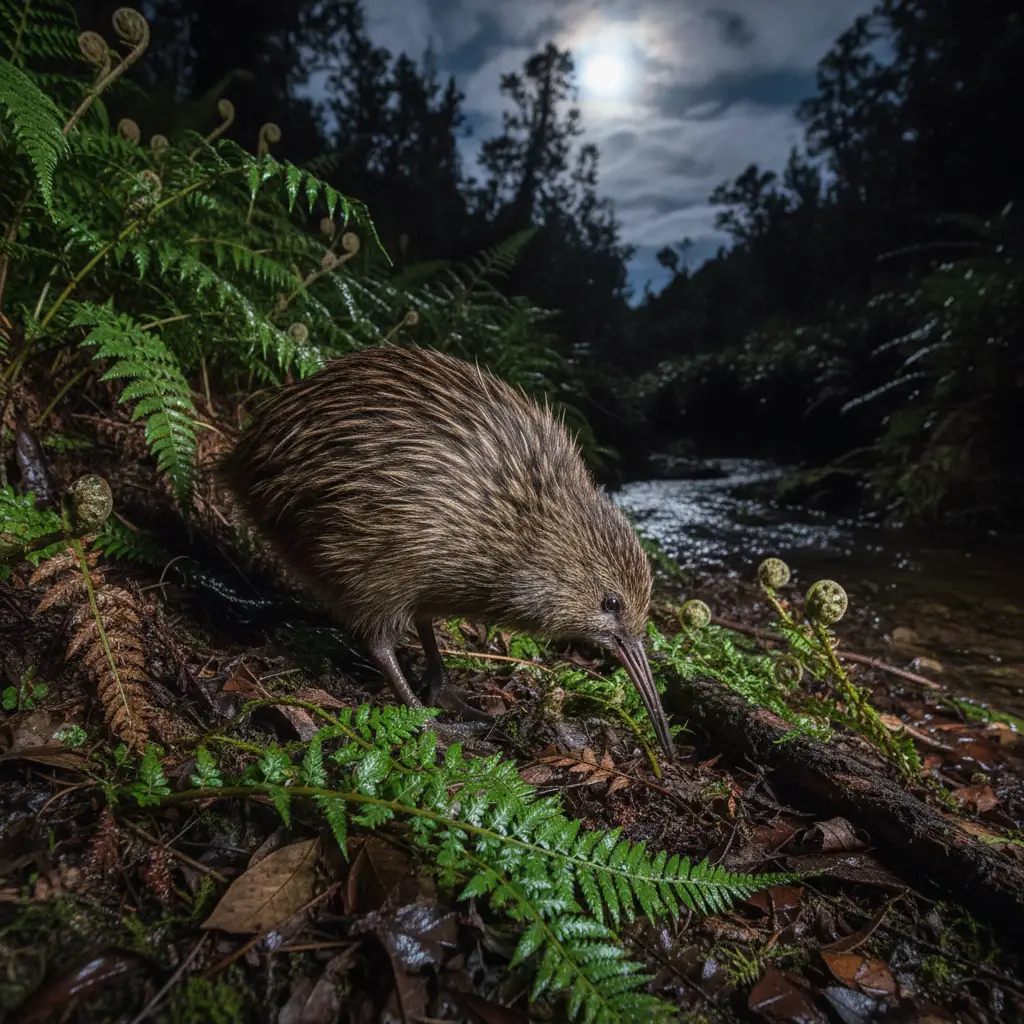
What are the key features of the Kiwi?
The Kiwi is a biological oddity and the national icon. There are five distinct species: Brown, Great Spotted, Little Spotted, Rowi, and Tokoeka. All share the same general characteristics that make identification unmistakable: a pear-shaped body, hair-like feathers, strong legs for digging, and no visible wings or tail.
Uniquely, their nostrils are located at the tip of their long, curved bill, allowing them to smell prey (invertebrates) underground. They are primarily nocturnal. While seeing one in the wild is rare without a guide, their presence is often confirmed by their calls. The male’s call is a shrill, ascending whistle, while the female’s is a lower, guttural cry. Evidence of Kiwi includes probe holes in the soil and distinct three-toed footprints.
How is the Weka different from the Kiwi?
Tourists often mistake the Weka (Gallirallus australis) for a Kiwi, but there are distinct differences. The Weka is a large, brown, flightless rail that is diurnal (active during the day). If you see a flightless brown bird walking around a campsite or crossing a road in broad daylight, it is almost certainly a Weka, not a Kiwi.
Weka have a stout, reddish-brown bill (shorter than a Kiwi’s) and a strong, inquisitive nature. They are notorious for stealing shiny objects and food. Their plumage is mottled brown and black, providing excellent camouflage in the leaf litter. Their call is a loud, repetitive “coo-et” usually heard at dusk.
Alpine Specialists: The Kea
In the high altitudes of the South Island, the environment is harsh, yet it is home to one of the most intelligent birds on the planet.
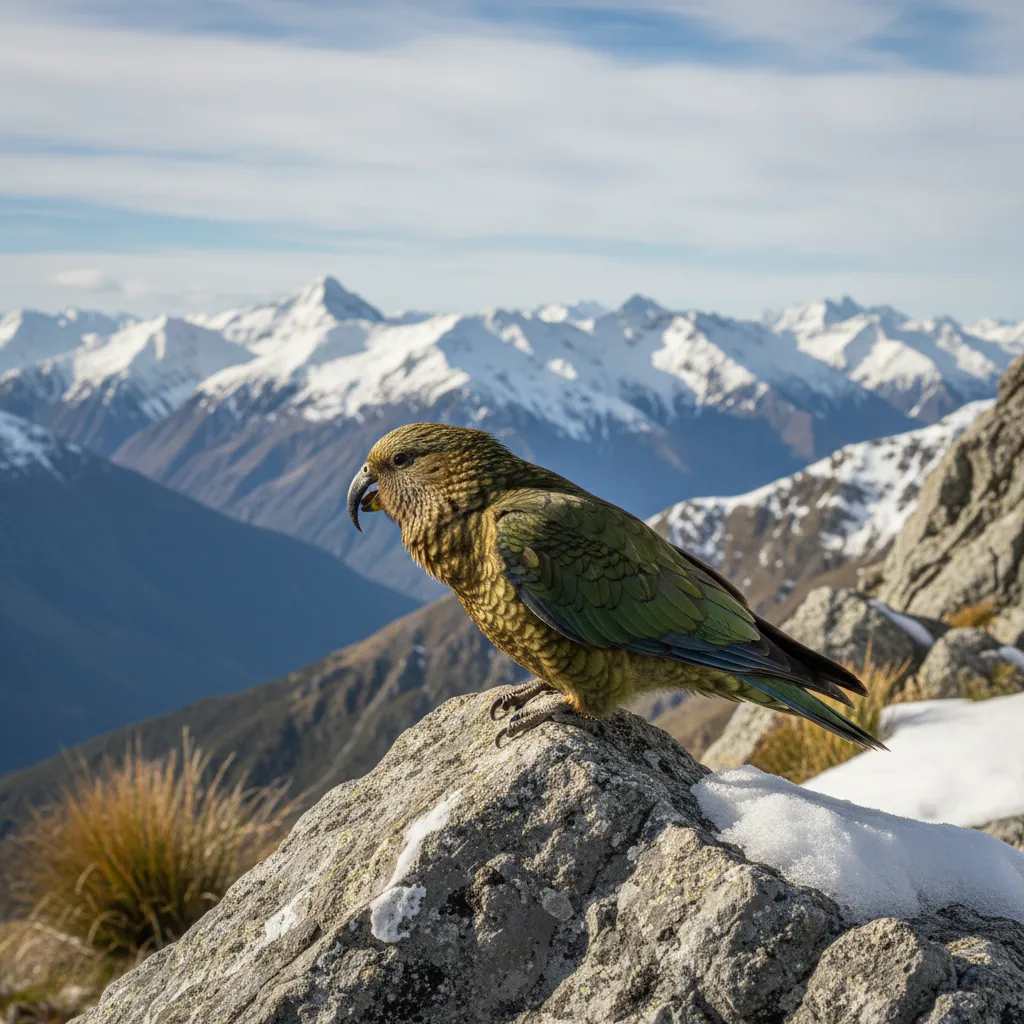
What makes the Kea unique?
The Kea (Nestor notabilis) is the world’s only alpine parrot. Identification is easy: it is a large, olive-green parrot with a long, curved upper beak. The most striking feature is revealed in flight—bright orange-red feathers on the underside of the wings.
Kea are renowned for their intelligence and neophilia (love of new things). They are often found around ski fields and mountain huts, investigating (and dismantling) cars, backpacks, and boots. While their antics can be amusing, they are endangered. It is critical not to feed them, as human food harms their health and alters their natural foraging behaviors. Their call is a loud, rolling “keee-aaa,” often echoing through the mountain valleys.
Bird Call Identification Resources
Visual identification is often difficult in the dense New Zealand bush. Mastering audio identification is a crucial skill for any birdwatcher in Aotearoa.
What does the Ruru (Morepork) sound like?
The Ruru is New Zealand’s only surviving native owl. Its Maori name is onomatopoeic, derived from its call: a melancholic, two-tone “ru-ru” or “more-pork.” Hearing this sound at night is a classic New Zealand experience. They are speckled brown with piercing yellow eyes, usually spotted roosting in dense canopy during the day.
Top Resources for Learning Calls
To differentiate between the complex songs of the native birds of Aotearoa, utilize the following high-authority resources:
- NZ Birds Online: The comprehensive digital encyclopedia of New Zealand birds, featuring high-quality audio recordings for almost every species.
- Department of Conservation (DOC) Website: Offers educational tracks and “bird call of the day” features.
- Merlin Bird ID App: While global, its database for New Zealand is improving and can help identify birds by photo and sound.
Conservation Status and Threats
Despite their beauty, many native birds of Aotearoa are in a precarious position. Because they evolved in the absence of mammalian predators, many species lack the instinctual defenses against introduced pests like stoats, rats, and possums.
The Predator Free 2050 Goal
The New Zealand government has set an ambitious goal to eradicate the most damaging introduced predators by the year 2050. This initiative is vital for the survival of ground-nesting birds like the Kiwi and Kākāpō. Conservation efforts include widespread trapping, aerial 1080 operations in rugged terrain, and the creation of predator-free sanctuaries (both mainland fenced sanctuaries like Zealandia and offshore islands like Kapiti Island).
Visitors can contribute to these efforts by strictly adhering to biosecurity rules when visiting island sanctuaries (checking bags for pests/seeds) and supporting eco-tourism operators that donate a portion of their proceeds to conservation trusts.
People Also Ask
What is the most common native bird in New Zealand?
The Tui and the Fantail (Pīwakawaka) are among the most common and widespread native birds. They have adapted relatively well to urban environments and can often be found in suburban gardens as well as native forests.
Are there any dangerous birds in New Zealand?
No native birds in New Zealand are dangerous to humans. However, the Kea has a strong beak capable of ripping rubber and fabric, and the New Zealand Falcon (Kārearea) may swoop at intruders during nesting season to protect their young.
What is the difference between endemic and native birds?
Native birds are those that naturally arrived in New Zealand (like the Pūkeko, which flew from Australia). Endemic birds (like the Kiwi and Tui) are found only in New Zealand and nowhere else in the world, usually having evolved there for millions of years.
Where is the best place to see Kiwi birds in the wild?
Stewart Island (Rakiura) is one of the best places to spot Kiwi in the wild, as the local Tokoeka species is active during the day and early evening. Wildlife sanctuaries like Zealandia (Wellington) and Rotoroa Island also offer high chances of sightings.
Why are so many New Zealand birds flightless?
New Zealand split from the supercontinent Gondwana around 80 million years ago before mammals evolved. Without mammalian predators to hunt them, birds did not need to fly to escape, leading to the evolution of flightless species to fill ground-dwelling ecological niches.
Can I feed native birds in New Zealand?
It is generally discouraged to feed native birds, especially the Kea, as human food is harmful to them. However, you can plant native trees like Kowhai and Flax to provide natural food sources for nectar-eaters like Tui and Bellbirds in your garden.