Light pollution effects on wildlife are characterized by the disruption of natural circadian rhythms, the alteration of navigational cues, and the suppression of melatonin production. In New Zealand, this artificial light at night (ALAN) critically impacts endemic species like the Kiwi and Westland Petrel, leading to disorientation, fatal collisions, and reduced reproductive success.
How does light pollution disrupt ecological balance?
The introduction of artificial light at night (ALAN) into natural environments is one of the most pervasive alterations of the biosphere. For billions of years, life on Earth has evolved under a rhythmic cycle of bright days and dark nights. This scotobiology—the biology of darkness—is fundamental to the survival of most species. When we flood the night with artificial photons, we are not merely erasing the stars; we are fundamentally altering the biological signals that govern life.
Light pollution acts as an ecological stressor that operates on multiple levels. Physiologically, it suppresses the production of melatonin, a hormone vital for regulating sleep, immune response, and oxidative stress in vertebrates. Behaviorally, it transforms the landscape, creating “fear barriers” that fragment habitats for light-sensitive species while creating unnatural hunting grounds for predators. In the context of New Zealand’s unique ecosystem, where a high proportion of native species are nocturnal, the stakes are exceptionally high.
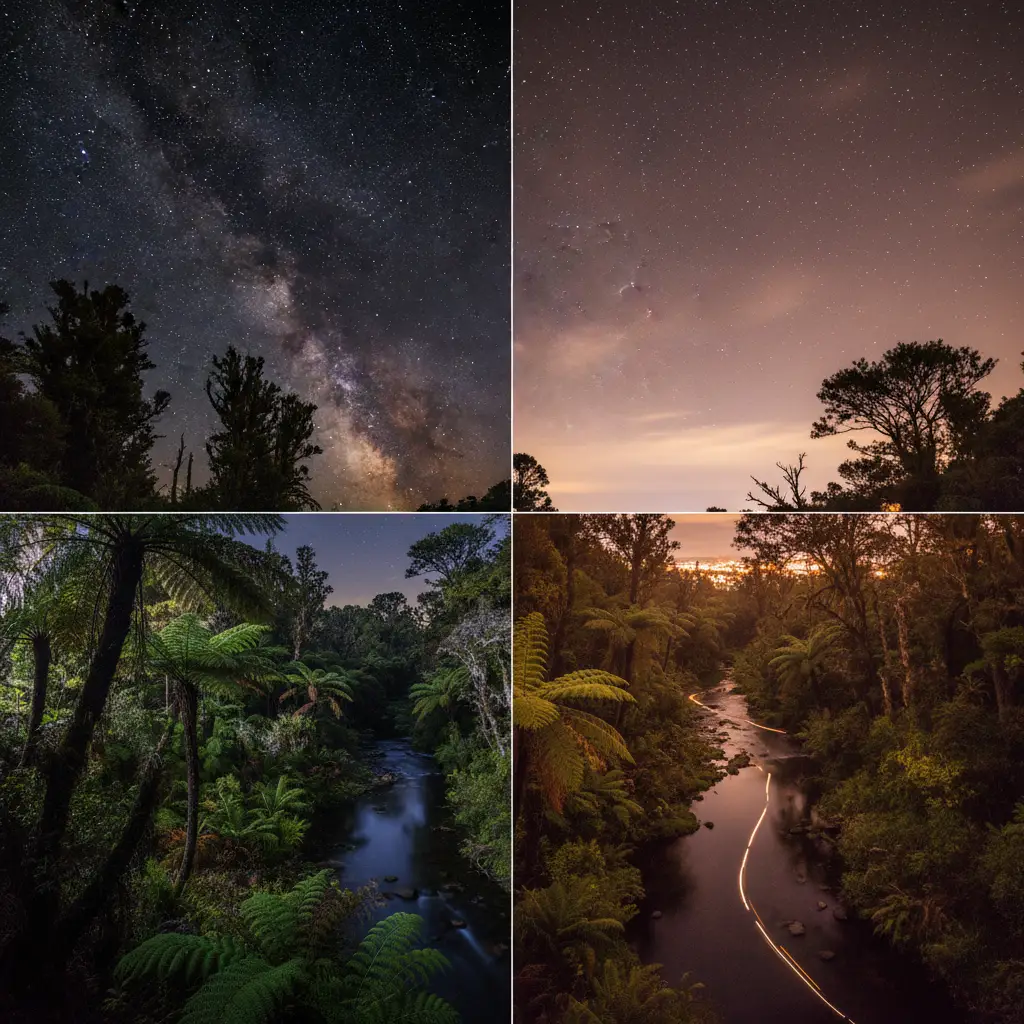
The disruption extends beyond individual animals to entire food webs. When the timing of predator activity shifts due to extended twilight caused by skyglow, prey species suffer. Conversely, if prey species avoid lit areas entirely, predators may face starvation. This cascading effect destabilizes the delicate balance of Aotearoa’s biodiversity, threatening conservation efforts that have taken decades to establish.
Why are nocturnal birds like the Kiwi and Ruru at risk?
New Zealand is often referred to as a land of birds, and a significant portion of its avifauna is nocturnal. The impact of light pollution on these species is profound, affecting their foraging efficiency, territory defense, and reproductive viability.
The Plight of the Kiwi
The Kiwi, Aotearoa’s national icon, is strictly nocturnal. These flightless birds rely on their senses of smell and touch to forage for invertebrates in the leaf litter. Studies suggest that Kiwi are highly sensitive to variations in ambient light. Under natural conditions, they are most active during the darkest phases of the moon. Artificial lighting mimics perpetual moonlight or twilight, which can suppress their foraging activity.
When Kiwi avoid lit areas, their available habitat shrinks effectively. This fragmentation forces them into smaller, darker pockets of bush, increasing competition for resources and reducing the likelihood of finding mates. Furthermore, if they are forced to forage closer to dawn or dusk to avoid artificial brightness, they become more visible to introduced predators such as stoats and dogs.
The Ruru (Morepork) and Altered Hunting Grounds
The Ruru, or Morepork, is New Zealand’s only surviving native owl. While they are adapted to low-light hunting, streetlights present a deceptive “buffet” scenario. Artificial lights attract moths and beetles, drawing Ruru out of the safety of the deep forest and into urban and peri-urban environments.
While this might seem advantageous initially due to the concentration of prey, it creates an ecological trap. Hunting near roads exposes Ruru to a high risk of vehicle collisions—a leading cause of death for the species. Additionally, the change in lighting alters the competitive advantage. Ruru rely on stealth and surprise; under the glare of LED streetlights, their camouflage is rendered ineffective, and their hunting success rates can plummet despite the abundance of prey.

What causes the disorientation of seabirds like the Westland Petrel?
One of the most tragic manifestations of light pollution effects on wildlife is the phenomenon known as “seabird fallout.” This is particularly acute for the Tāiko, or Westland Petrel, a species that breeds only on the West Coast of New Zealand’s South Island.
The Horizon Trap
Fledgling petrels, leaving their burrows for the first time to head out to sea, rely on visual cues to navigate. Evolution has programmed them to look for a bright horizon, which, in a natural setting, indicates the ocean reflecting starlight and moonlight. However, coastal settlements with unshielded streetlights and floodlights create a false horizon.
Instead of flying toward the safety of the open ocean, these young birds are drawn inland toward the lights. This fatal attraction results in “grounding.” Once a petrel lands on a road or driveway, it is often unable to take off again because these seabirds require a cliff edge or a strong headwind to become airborne. Grounded birds are vulnerable to being run over by cars or eaten by dogs and cats.
The Punakaiki Crisis
In regions like Punakaiki, local conservationists often patrol the streets during fledging season (November to January) to rescue grounded birds. The introduction of blue-rich white LED streetlights has exacerbated this problem. Research indicates that the blue spectrum is particularly disorienting to seabirds. This specific interaction between biology and technology highlights the urgent need for spectral management in lighting—using warmer, amber-colored lights that interfere less with avian navigation.

Is light pollution contributing to the decline of insects?
While the “Insect Apocalypse” is often attributed to pesticides and habitat loss, light pollution is a major, yet frequently overlooked, driver of insect decline. In New Zealand, this affects a vast array of endemic moths, beetles, and wētā.
The Vacuum Cleaner Effect
Artificial lights act as a vacuum cleaner for the ecosystem, sucking flying insects out of their natural habitats. This phenomenon, known as positive phototaxis, disrupts their normal behaviors. Moths that should be foraging or mating spend their energy circling a pointer light until they die of exhaustion or are picked off by predators (bats, spiders, and birds) that have learned to exploit these artificial feeding stations.
Pollination Interruption
Many plants rely on nocturnal pollinators. When moths are distracted by artificial lights, pollination rates drop significantly. This has a knock-on effect for the flora of New Zealand, potentially reducing the reproductive success of native plants that depend on these specific night-flying insects. The decline in insect biomass also threatens the species that feed on them, including the Kiwi and native bats (Pekapeka), creating a bottom-up trophic cascade.
How to make your home dark-sky friendly?
Combating light pollution is one of the most accessible forms of environmental conservation. Unlike removing microplastics from the ocean, fixing light pollution is often as simple as flipping a switch or changing a bulb. Here is how homeowners and tourism operators in New Zealand can protect wildlife.
1. Shielding and Targeting
Light should only fall where it is needed. Any light that escapes upward into the sky is wasted energy and a pollutant. Use fully shielded fixtures (cut-off fixtures) that direct light downward. If you can see the bulb from a distance, the lighting is poorly designed.
2. Color Temperature Matters
Not all light is created equal. White and blue-rich LEDs (above 3000 Kelvin) are the most damaging to wildlife because they mimic the midday sun, suppressing melatonin and causing maximum disorientation. Opt for “warm white” or amber LEDs with a color temperature of 2700K or lower. Special amber LEDs are now available that emit almost no blue light, making them ideal for coastal properties near seabird colonies.
3. Intensity and Timing
Brighter is not safer; it often creates harsh shadows that reduce visibility. Use the lowest wattage necessary for the task. Furthermore, employ adaptive controls such as timers and motion sensors. Lights should not be left on all night. A motion sensor ensures safety when you need it but restores the darkness for the wildlife when you don’t.

The Economic Value of Dark Skies
For New Zealand’s eco-tourism sector, preserving the night sky is also an economic imperative. Dark Sky Sanctuaries, such as those in the Mackenzie Basin and Great Barrier Island, attract international visitors. By adopting dark-sky friendly practices, accommodation providers protect the wildlife that tourists come to see and preserve the pristine star-scapes that define the Aotearoa experience.
Frequently Asked Questions
What animals are most affected by light pollution?
Nocturnal animals are most severely affected, including migrating birds, sea turtles hatchlings, and insects. In New Zealand, this includes the Kiwi, Morepork (Ruru), Westland Petrel, and native bats (Pekapeka), all of which rely on darkness for hunting and navigation.
How does light pollution affect bird migration?
Many birds migrate at night to avoid predators and overheating. Artificial lights from cities can draw them off course, causing them to expend vital energy reserves. This disorientation often leads to fatal collisions with illuminated buildings and communication towers.
Why do insects fly towards lights?
While the exact mechanism is debated, the leading theory is “dorsal light response,” where insects use the brightest light source (naturally the moon or sky) to orient their backs and maintain flight stability. Artificial lights confuse this mechanism, causing them to spiral endlessly around the bulb.
Does light pollution affect human health?
Yes. Just like wildlife, humans have circadian rhythms regulated by light and dark. Exposure to artificial light at night, particularly blue light from screens and LEDs, suppresses melatonin production, which has been linked to sleep disorders, obesity, and increased risk of certain cancers.
What is the best color light for wildlife?
Red and amber lights are the least disruptive to wildlife. Long-wavelength light (red/amber) interferes less with melatonin production and navigational cues than short-wavelength light (blue/white). Aim for a color temperature of 2200K to 2700K.
Can light pollution be reversed?
Yes, light pollution is the only form of pollution that can be immediately reversed. By turning off unnecessary lights, shielding fixtures, and using warmer bulbs, the natural darkness can be restored instantly, allowing ecosystems to recover quickly.